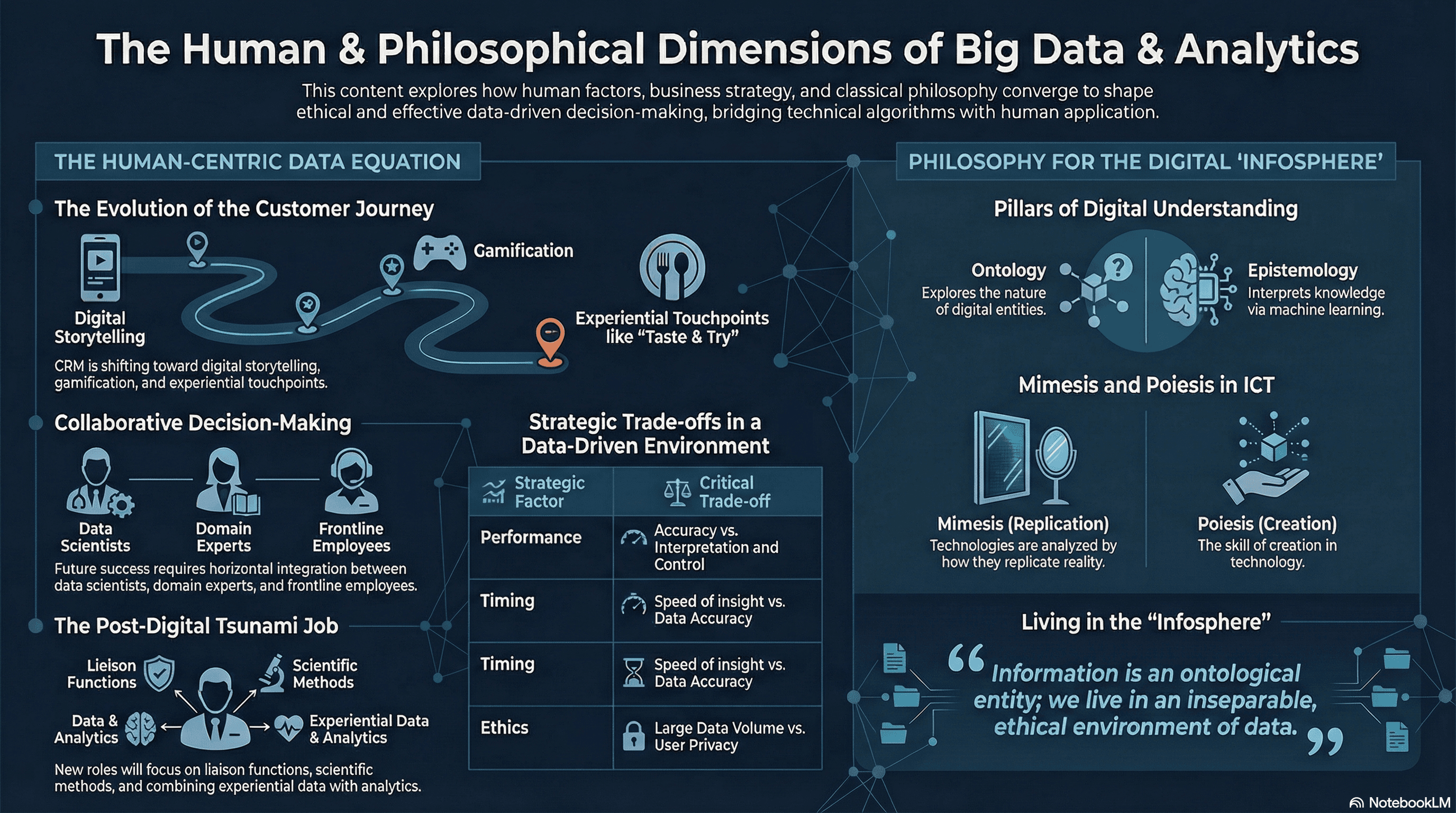
1. Introduction: The Human-Centric Paradigm in Analytics
The most sophisticated algorithms and largest datasets remain fundamentally inert without human interpretation, judgment, and ethical grounding. This lecture repositions analytics as a human-centric discipline, exploring three critical lenses:
- The Customer Lens: How digital transformation reshapes consumer relationships
- The Workforce Lens: How organizations must adapt to the "digital tsunami"
- The Philosophical Lens: How we understand knowledge, reality, and responsibility in the Infosphere
Central Thesis: Data does not speak for itself. It becomes valuable only when animated by human questions, contextualized by domain expertise, and constrained by ethical boundaries.
2. Redefining the Customer Journey in the Digital Era
The Power Shift: From Brands to Consumers
Traditional marketing assumed asymmetric information: brands knew more about products than consumers. The internet demolished this assumption. Today's consumers:
- Research independently across multiple channels
- Compare prices instantly
- Access peer reviews and influencer opinions
- Demand transparency about ingredients, sourcing, and ethics
Strategic Implication: Brands must shift from persuasion to facilitation. The customer journey is no longer a funnel controlled by marketing; it's a complex, non-linear exploration where consumers are empowered architects of their own experiences.
New Touchpoints in F&B
Digital transformation creates novel engagement opportunities:
1. Taste & Try (Data-Rich Engagement)
- QR codes on packaging linking to recipes, pairings, sustainability stories
- Virtual tastings with real-time feedback collection
- Augmented Reality (AR) product visualizations
2. Do It Yourself (Consumer Empowerment)
- Customizable product configurations (flavor profiles, portion sizes)
- User-generated content campaigns
- Co-creation platforms (crowdsourced flavors, packaging designs)
3. Experience (Immersive Sensory Data Capture)
- Wine tastings that capture biometric responses (heart rate, facial expressions)
- Pop-up restaurants as data laboratories
- Subscription boxes with A/B testing built into product selection
Modern CRM: Beyond Transactional Data
Customer Relationship Management evolves from transactional tracking to experiential engagement:
Fidelity Cards: No longer just discount mechanisms, but data exchange platforms
- Consumers trade behavioral data for personalized value
- Real-time offers based on location, purchase history, and preferences
Gamification: Loyalty becomes playful
- Points, badges, leaderboards
- Challenges (e.g., "Try 5 new products this month")
- Community building through shared achievements
Immersive Experiences: Brands become destinations
- Coca-Cola World, Guinness Storehouse, Lavazza flagship stores
- Education + entertainment + data collection
Value-Based Advertising: The Rise of "Eat-arian New Religions"
Demographics (age, income, location) are insufficient. Psychographics (values, beliefs, lifestyles) drive modern segmentation:
The "Eat-arian" Movements:
- Bio-conscious: Organic, non-GMO, minimal processing
- Sustainability-driven: Carbon footprint, regenerative agriculture, fair trade
- Health-optimizers: Keto, paleo, intermittent fasting, personalized nutrition
- Ethical eaters: Veganism, cruelty-free, local sourcing
Advertising Strategy Shift:
- From features ("20% more protein") to values ("Supporting regenerative farms")
- From mass messaging to micro-communities aligned around shared beliefs
- From interruption to invitation (content, storytelling, education)
3. The Strategic Trade-offs of Data-Driven Decision Making
Every data-driven decision involves unavoidable trade-offs. Mature organizations explicitly acknowledge and manage these tensions rather than pretending they don't exist.
Four Pillars of Trade-offs
Trade-off 1: Interpretation vs. Control (Accuracy vs. Explainability)
The Dilemma: Complex models (neural networks) achieve higher accuracy but function as "black boxes." Simple models (linear regression) are transparent but less powerful.
Business Context:
- Regulatory environments (finance, healthcare, F&B safety) may require explainability
- Innovation contexts may prioritize predictive power over understanding
- Hybrid approaches: Use complex models for prediction, simple models for explanation
Strategic Question: What is the cost of being right for the wrong (unknown) reasons?
Trade-off 2: Execution Speed (Agility vs. Rigor)
The Dilemma: Fast decisions enable competitive responsiveness but increase error risk. Slow, thorough analysis ensures quality but may miss market windows.
Business Context:
- High-stakes decisions (M&A, product recalls) demand rigor
- Tactical optimizations (pricing adjustments, promotional tactics) favor speed
- Reversibility matters: If decisions are easily reversed, optimize for speed
Strategic Question: What is the opportunity cost of waiting for perfect information?
Trade-off 3: Ethical Boundary (Data Collection vs. Privacy)
The Dilemma: More data improves personalization and prediction but erodes privacy and trust. Regulatory frameworks (GDPR, CCPA) impose legal constraints, but ethics extend beyond legality.
Business Context:
- Trust is an asset: Privacy violations create existential brand risk
- Competitive differentiation: Privacy-first positioning (Apple's "What happens on your iPhone stays on your iPhone")
- Long-term vs. short-term: Exploiting data maximizes short-term revenue; respecting privacy builds long-term loyalty
Strategic Question: What data could we collect but should choose not to?
Trade-off 4: Model Utility (Explanation vs. Prediction)
The Dilemma: Models optimized for prediction may identify spurious correlations. Models focused on causal explanation sacrifice predictive power for interpretability.
The Ice Cream / Murder Correlation Example:
- Observation: Ice cream sales and murder rates are positively correlated
- Spurious Correlation: Both driven by a third variable (summer heat)
- Prediction: The correlation is real and useful for forecasting
- Explanation: The correlation is misleading if interpreted causally
Business Context:
- Forecasting (demand planning, inventory) can tolerate spurious correlations if they're stable
- Strategic decisions (where to invest, what to change) require causal understanding
Strategic Question: Do we need to know why, or only what will happen?
Big Data vs. Small Data: Complementary, Not Competitive
Big Data:
- Strength: Optimization, pattern detection, incremental improvement
- Limitation: Confirms existing paradigms, struggles with novelty
Small Data:
- Strength: Innovation, hypothesis generation, contextual richness
- Limitation: Not scalable, prone to anecdotal bias
Strategic Synthesis:
- Small Data generates hypotheses: Ethnographic research, user interviews, experiential insights
- Big Data tests hypotheses: A/B testing, multivariate analysis, scalability validation
- Iteration: Insights from Big Data inform new Small Data explorations
Example: Starbucks mobile order adoption
- Small Data: Observational research revealed customer frustration with wait times
- Hypothesis: Mobile pre-ordering would improve satisfaction
- Big Data: Pilot rollout, multivariate testing, national scale-up
- Result: Mobile orders now represent 25%+ of transactions
4. The Future of Work: Collaboration in the Wake of the Digital Tsunami
The Obsolescence of Silos
Traditional organizational structures—Marketing, Finance, IT, Operations functioning independently—are incompatible with data-driven business models.
The Digital Tsunami: The volume, velocity, and complexity of data overwhelm siloed expertise. No single department possesses the technical, domain, and strategic knowledge required for effective analytics.
Three Collaborative Pillars
Pillar 1: Liaison Roles ("Translators")
The Gap: Data scientists speak Python; executives speak ROI. Miscommunication creates implementation failure.
The Solution: Hybrid roles bridging technical and strategic domains
- Titles: Analytics Translators, Business Intelligence Managers, Data Product Managers
- Skills: Bilingual fluency (technical + business), storytelling, stakeholder management
- Impact: Converts analytical outputs into actionable business recommendations
Pillar 2: Scientific Method in Business
Traditional Business: Intuition, experience, hierarchy determine decisions
Data-Driven Business: Hypotheses, experiments, evidence guide decisions
Process:
- Hypothesis Formation (Small Data): "Customers prefer sustainable packaging"
- Experimental Design: A/B test two packaging options in controlled geographies
- Data Collection (Big Data): Sales, surveys, social sentiment
- Analysis: Statistical significance testing
- Decision: Scale winning variant or iterate
Cultural Shift: Mistakes become "learning opportunities" rather than career risks. Psychological safety enables experimentation.
Pillar 3: Hybrid Synthesis (Context + Data)
The Fallacy: "Data will tell us what to do"
The Reality: Data answers questions posed by humans. Context determines which questions matter.
Example: Netflix recommendation algorithm
- Pure Data Approach: Optimize for engagement (watch time)
- Contextual Insight: Engagement ≠ satisfaction. Binge-watching may create regret, churn
- Hybrid Solution: Balance short-term engagement with long-term satisfaction signals
5. The Philosophical Foundations of the Digital Age
Understanding the digital transformation requires grappling with fundamental questions of knowledge, reality, and responsibility.
The Four Classical Pillars
Ontology: The Nature of Digital Entities
Fundamental Question: What does it mean for a database, an algorithm, or an AI to "exist"?
Implications:
- If data is an "asset," what obligations does ownership entail?
- If algorithms make consequential decisions, do they bear responsibility?
- If AI-generated content is indistinguishable from human-created content, what is "authentic"?
Epistemology: Theory of Knowledge
Fundamental Question: How do we "know" from machine learning outputs? What is the status of knowledge derived from correlations rather than causal understanding?
Implications:
- Do we "understand" a phenomenon if we can predict it accurately but can't explain why?
- Can knowledge generated by non-sentient algorithms be considered "true" in the same way human-derived knowledge is?
Mimesis: Digital Reconfiguration of Authenticity
Fundamental Question: When digital representations replace physical experiences, what is lost? What is gained?
Implications:
- Virtual wine tastings, digital product showrooms, AI-generated customer service
- The "uncanny valley" of AI-human interaction
- Authenticity as constructed vs. discovered
Poiesis: Responsibility of the "Maker"
Fundamental Question: If we create technologies that reshape society, what ethical obligations follow from that creation?
Implications:
- Engineers and data scientists are not neutral technicians; they're "makers" shaping reality
- With the power to create comes the responsibility to consider consequences
- Techne (craft/skill) must be paired with phronesis (practical wisdom)
6. Ontological Poietic Epistemology: Living in the Infosphere
Floridi's Infosphere Concept
Luciano Floridi argues that we do not merely use information technologies; we inhabit an Infosphere just as we inhabit the biosphere.
Core Insight: Information is not a passive resource we extract and manipulate. It is the ontological environment in which we exist.
Analogy:
- Biosphere: Physical environment (air, water, ecosystems) that sustains biological life
- Infosphere: Informational environment (data flows, digital identities, algorithmic mediations) that sustains contemporary existence
Implication: Corrupting the Infosphere is not merely an economic or technical failure—it is an existential threat to the environment of human flourishing.
The Framework: Knowing Rooted in Creating
Ontological: The nature of things (what information "is") Poietic: The act of creation (what we make with information) Epistemological: The theory of knowledge (how we know through information)
Integration: Our knowledge of the digital world is inseparable from our responsibility for creating it. We cannot claim ignorance of consequences when we are the architects.
Practical Applications
Data Security as Protecting Human Being
Traditional View: Data security prevents financial loss or competitive disadvantage
Ontological View: Data security protects the integrity of the Infosphere, which is constitutive of human existence in the digital age
Implication: Breaches are not just "incidents"; they're corruptions of the environment we inhabit
Reliability Assessment Aligned with Societal Values
Traditional View: Algorithms are "reliable" if they perform accurately on test datasets
Ontological View: Algorithms are reliable only if they align with societal values and contribute to human flourishing
Implication: Accuracy is necessary but insufficient. Ethical alignment is non-negotiable.
Social Responsibility Over Functionality
Traditional View: If it works, deploy it. Ethics are constraints on innovation.
Ontological View: Functionality without responsibility is dangerous. Ethics enable sustainable innovation.
Implication: "Can we?" is less important than "Should we?"
Ethical Gravity
The Stakes: Failure in the Infosphere is not a localized error but a degradation of the existential environment.
Example: Algorithmic bias in hiring
- Technical failure: Model inaccuracy
- Ontological failure: Corruption of fairness as a foundational principle of society
- Consequence: Erosion of trust, reinforcement of inequality, delegitimization of institutions
Responsibility: Expertise and ethics are inextricably linked. Technical competence without ethical grounding is not merely incomplete—it is irresponsible.
Key Takeaways
-
Data is Silent Without Human Judgment: Analytics is fundamentally a human discipline. Algorithms amplify human questions, biases, and values.
-
Customer Journeys Have Transformed: Power has shifted from brands to consumers. Engagement must be experiential, value-aligned, and participatory.
-
Trade-offs Are Unavoidable: Mature organizations explicitly acknowledge tensions between accuracy and explainability, speed and rigor, data collection and privacy, prediction and explanation.
-
Big Data and Small Data Are Complementary: Big Data optimizes; Small Data innovates. Both are necessary.
-
Collaboration is Non-Negotiable: The digital tsunami overwhelms siloed expertise. Liaison roles, scientific method, and hybrid synthesis are organizational imperatives.
-
Philosophy Grounds Practice: Ontology, epistemology, mimesis, and poiesis provide frameworks for understanding the profound implications of digital transformation.
-
We Live in the Infosphere: Information is not external to us; it is the environment of contemporary existence. Corrupting it is an existential threat.
-
Ethics and Expertise Are Inseparable: Technical capability without ethical responsibility is dangerous. We are "makers" of the digital world and bear responsibility for what we create.
Key Questions
-
Analyze the organizational transformation required to build a data-driven culture using the Three Pillars framework (Talent-Analytics-Context, Scientific Method, Hybrid Synthesis). For a traditional F&B manufacturer transitioning to data-driven operations, design a 3-year transformation roadmap that addresses technical capabilities, organizational processes, and cultural mindset shifts. Identify the most critical early wins and the most challenging cultural barriers.
-
Critically evaluate the role of philosophical frameworks (Ontology, Epistemology, Axiology, Logic) in shaping AI governance policies for an F&B company. Using a specific example (e.g., algorithmic pricing, supplier selection, hiring decisions), explain how each philosophical dimension informs ethical considerations and governance requirements. How do these abstract principles translate into concrete policy guardrails?
-
Compare the Turing Test, Chinese Room argument, and Moravec Paradox as lenses for understanding AI capabilities and limitations. What does each framework reveal about the boundary between human and machine intelligence? How should these philosophical distinctions inform the allocation of decision-making authority between humans and AI systems in F&B operations (e.g., which decisions should remain "human-in-the-loop" vs. fully automated)?
-
Design a comprehensive AI governance framework for a multinational F&B corporation, addressing: (a) algorithmic bias detection and mitigation, (b) privacy and data protection compliance (GDPR, local regulations), (c) explainability requirements for regulatory and consumer trust, (d) accountability structures for algorithmic decisions, and (e) workforce impact management (reskilling, job displacement). Justify your framework using principles from digital ethics and responsible AI.
-
Evaluate Floridi's concept of the Fourth Revolution and the Infosphere in the context of F&B digital transformation. How does framing information as an existential environment (rather than a tool) change strategic thinking about data, algorithms, and customer relationships? Provide specific examples of how this philosophical shift might alter business model design, competitive strategy, or innovation priorities in the F&B sector.
Discussion Prompts
-
Identify a recent business decision in your organization that involved a trade-off between two competing values (e.g., speed vs. accuracy, personalization vs. privacy). How was the trade-off resolved? Was it made explicit, or did it happen implicitly?
-
Consider your organization's customer journey. Which touchpoints are transactional vs. experiential? How could you shift toward more immersive, data-rich engagement?
-
Reflect on Floridi's concept of the Infosphere. What responsibilities follow from the recognition that we "inhabit" information rather than merely "use" it? How does this change the way you think about data governance, algorithmic decision-making, or digital ethics?
Further Reading
- Floridi, L. (2016). The Fourth Revolution: How the Infosphere Is Reshaping Human Reality. Oxford University Press.
- Mollick, E. (2024). Co-Intelligence: Living and Working with AI. Portfolio.