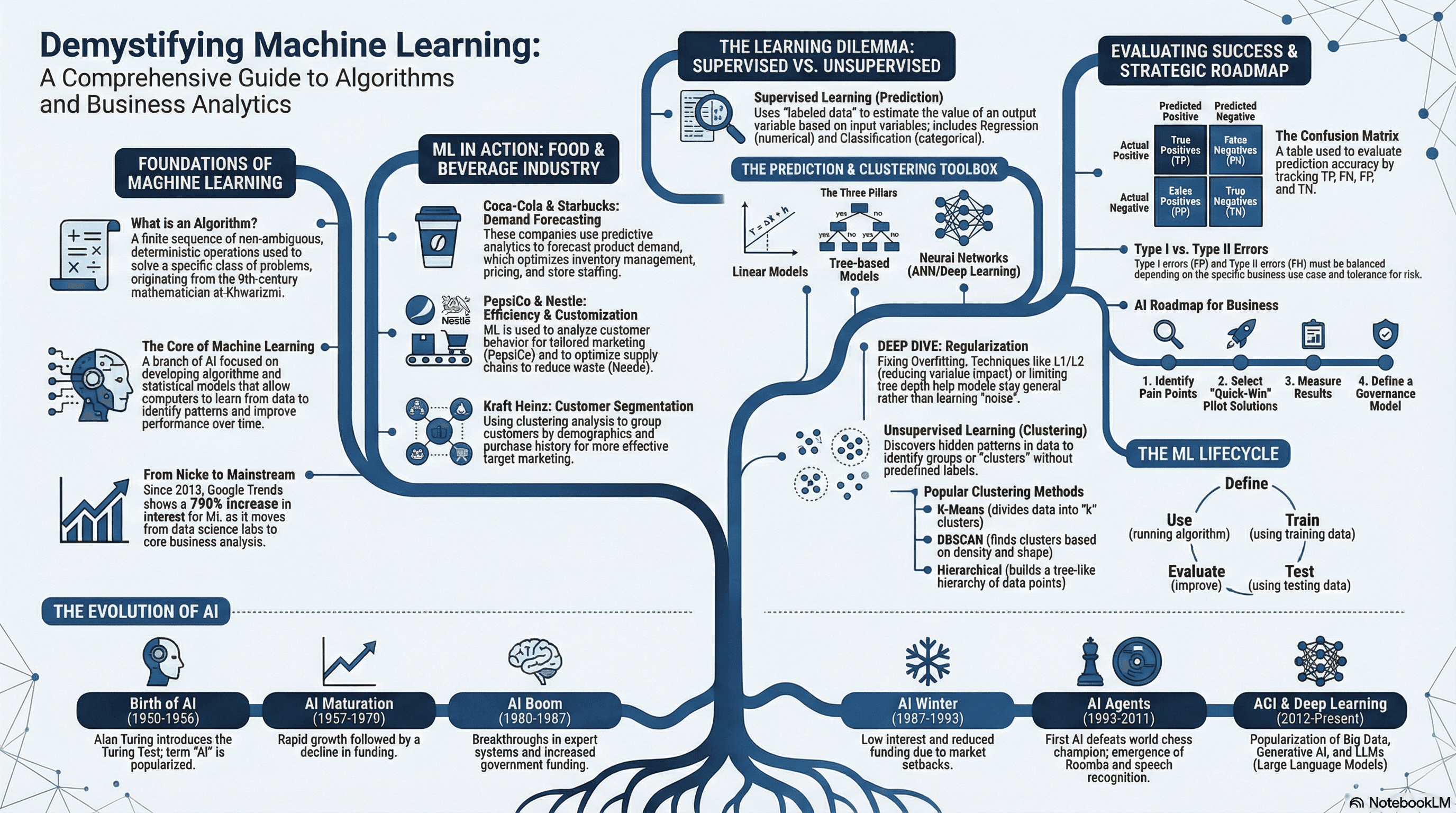
1. ML Algorithm Selection: Matching Tools to Problems
Selecting the appropriate algorithm requires understanding both the problem structure and algorithmic characteristics.
Decision Framework
Question 1: What are you predicting?
- Numerical value → Regression algorithms
- Category/class → Classification algorithms
- No prediction, finding patterns → Clustering algorithms
Question 2: How much data do you have?
- < 1,000 samples → Simple models (linear regression, logistic regression)
- 1,000 - 100,000 samples → Tree-based models (random forests, gradient boosting)
- > 100,000 samples → Neural networks (deep learning)
Question 3: Do you need interpretability?
- Yes, must explain predictions → Linear models, decision trees
- No, only accuracy matters → Ensemble methods, neural networks
2. Feature Engineering: The Art of ML
Feature engineering—transforming raw data into meaningful model inputs—often determines success more than algorithm choice.
Types of Features
1. Numerical Features:
- Raw values (temperature, price, quantity)
- Transformed (log, square root, polynomial)
- Aggregations (mean, median, standard deviation)
2. Categorical Features:
- One-hot encoding (converting categories to binary columns)
- Label encoding (converting to integers)
- Frequency encoding (using category frequency as feature)
3. Time-Based Features:
- Day of week, month, quarter
- Time since last event
- Rolling windows (7-day average, 30-day trend)
4. Text Features:
- Bag of words (word frequency counts)
- TF-IDF (term frequency-inverse document frequency)
- Word embeddings (semantic vector representations)
F&B Example: Demand Forecasting Features
Raw Data: Daily sales transactions
Engineered Features:
- Time: Day of week, month, holiday indicator
- Lag: Sales 7, 14, 30 days ago
- Rolling Stats: 7-day average, 30-day trend
- External: Weather, local events, promotions
- Product: Category, price tier, seasonality
Impact: Proper feature engineering can improve model accuracy by 20-50% compared to using raw data alone.
3. Model Evaluation: Beyond Accuracy
Accuracy alone is insufficient for evaluating model performance. Different metrics matter for different business contexts.
Classification Metrics
Confusion Matrix Components:
- True Positive (TP): Correctly predicted positive
- True Negative (TN): Correctly predicted negative
- False Positive (FP): Incorrectly predicted positive (Type I Error)
- False Negative (FN): Incorrectly predicted negative (Type II Error)
Derived Metrics:
\text{Precision} = \frac{TP}{TP + FP}
"Of all positive predictions, how many were correct?"
\text{Recall} = \frac{TP}{TP + FN}
"Of all actual positives, how many did we catch?"
\text{F1 Score} = 2 \times \frac{\text{Precision} \times \text{Recall}}{\text{Precision} + \text{Recall}}
"Harmonic mean balancing precision and recall"
Business Context Determines Metric Priority
Food Safety Detection (Contamination):
- Priority: High Recall (catch all contaminated products)
- Trade-off: Accept false positives (wasting some good product)
- Rationale: Missing contamination is catastrophic
Customer Churn Prediction:
- Priority: High Precision (target retention offers accurately)
- Trade-off: Accept false negatives (missing some at-risk customers)
- Rationale: Retention campaigns are costly; targeting wrong customers wastes budget
Regression Metrics
Mean Absolute Error (MAE):
MAE = \frac{1}{n} \sum_{i=1}^{n} |y_i - \hat{y}_i|
Average absolute difference between predictions and actuals
Root Mean Squared Error (RMSE):
RMSE = \sqrt{\frac{1}{n} \sum_{i=1}^{n} (y_i - \hat{y}_i)^2}
Penalizes large errors more heavily than MAE
R-squared (R²):
R^2 = 1 - \frac{\sum (y_i - \hat{y}_i)^2}{\sum (y_i - \bar{y})^2}
Proportion of variance explained by the model (0 = no better than mean, 1 = perfect)
4. Real-World F&B Applications
Application 1: Demand Forecasting
Business Problem: Inventory optimization (minimize waste + stockouts)
ML Approach: Time series regression with gradient boosting
Features:
- Historical sales (lag features)
- Seasonality (day, week, month)
- Promotions and pricing
- Weather and events
Performance:
- Baseline (historical average): RMSE = 250 units
- ML Model: RMSE = 120 units (52% improvement)
Business Impact: 15% inventory reduction, 8% waste reduction
Application 2: Quality Control (Visual Inspection)
Business Problem: Detect product defects on production line
ML Approach: Convolutional neural network (image classification)
Training Data: 50,000 labeled images (defective vs. acceptable)
Performance:
- Accuracy: 98.5%
- Recall (defect detection): 99.2%
- Precision: 97.8%
Business Impact:
- 24/7 inspection (vs. human fatigue)
- 30% reduction in defective products reaching customers
- ROI payback in 8 months
Application 3: Customer Segmentation
Business Problem: Personalized marketing for diverse customer base
ML Approach: K-means clustering on customer behavior data
Features:
- Purchase frequency and recency
- Average transaction value
- Product category preferences
- Channel preferences (online vs. in-store)
Segments Discovered:
- Premium Loyalists: High spend, frequent purchase, premium products
- Bargain Hunters: Price-sensitive, promotion-driven
- Occasional Indulgers: Infrequent but high-value purchases
- Routine Buyers: Consistent, predictable, mid-tier spending
Business Impact:
- Segment-specific campaigns: 25% higher conversion vs. mass marketing
- Retention improvement: 12% reduction in churn among Premium Loyalists
- Revenue growth: 8% from targeted upselling
Application 4: Dynamic Pricing
Business Problem: Optimize pricing for profitability and market share
ML Approach: Reinforcement learning with price elasticity modeling
Inputs:
- Historical price-demand relationships
- Competitor pricing
- Inventory levels
- Time-based factors
Strategy:
- High inventory + low demand → Price reduction to accelerate sales
- Low inventory + high demand → Price premium capture
- Competitive context → Match or undercut strategically
Business Impact:
- Revenue increase: 6-10% through optimized pricing
- Margin improvement: 3-5% through strategic premiums
- Inventory turnover: 20% faster
5. Common Pitfalls and Mitigation Strategies
Pitfall 1: Overfitting
Definition: Model learns training data too well, including noise, failing to generalize to new data.
Symptom: Excellent training performance, poor validation/test performance
Mitigation:
- Cross-validation: Evaluate on multiple train/test splits
- Regularization: Penalize model complexity (L1/L2 penalties)
- Simpler models: Reduce features or model capacity
- More data: Larger training sets reduce overfitting risk
Pitfall 2: Data Leakage
Definition: Training data contains information that wouldn't be available at prediction time.
Example: Predicting customer churn using "days since last login" as a feature. Churned customers have high values by definition, creating artificial perfect prediction.
Mitigation:
- Time-aware splits: Train on historical data, test on future data
- Feature scrutiny: Ensure features are available before prediction point
- Domain expertise: Validate features with business stakeholders
Pitfall 3: Biased Training Data
Definition: Training data is not representative of deployment context.
Example: Training fraud detection on historical fraud cases (which were caught), missing evolving fraud patterns that evade detection.
Mitigation:
- Data audits: Analyze training data distributions vs. production data
- Synthetic data: Augment with simulated edge cases
- Continuous learning: Retrain models regularly with recent data
6. ML Model Deployment and Maintenance
Production Deployment Considerations
1. Latency Requirements:
- Batch predictions (overnight): Complex models acceptable
- Real-time predictions (< 100ms): Optimized, lightweight models required
2. Monitoring:
- Model performance: Track accuracy/RMSE over time
- Data drift: Detect distribution changes in input features
- Prediction drift: Monitor output distribution shifts
3. Retraining Cadence:
- Static environments: Quarterly or semi-annual retraining
- Dynamic environments: Weekly or monthly updates
- Trigger-based: Retrain when performance degrades below threshold
Key Takeaways
-
Algorithm Selection is Problem-Specific: Data size, interpretability needs, and problem structure dictate optimal algorithms.
-
Feature Engineering > Algorithm Choice: Thoughtful feature design typically improves performance more than selecting sophisticated algorithms.
-
Metrics Must Align with Business Goals: Accuracy alone is insufficient. Precision, recall, and error costs must reflect real-world priorities.
-
F&B Applications are Diverse: From demand forecasting to quality control to personalization, ML addresses strategic challenges across the value chain.
-
Pitfalls are Predictable: Overfitting, data leakage, and bias are common but avoidable with disciplined methodology.
-
Deployment ≠ End: Production ML requires monitoring, maintenance, and continuous improvement.
Key Questions
-
Design a complete ML pipeline for demand forecasting in a multinational F&B company. Specify: (a) data sources and feature engineering strategy, (b) algorithm selection and justification (consider data volume, interpretability needs, and problem complexity), (c) performance metrics aligned with business objectives, (d) deployment architecture, and (e) monitoring strategy for detecting model degradation.
-
Compare Random Forest and Neural Network approaches for a food quality inspection system. Analyze each approach across five dimensions: interpretability, data requirements, computational cost, accuracy potential, and deployment complexity. Given regulatory requirements for explainability in food safety, which approach would you recommend and why?
-
Explain the Bias-Variance Tradeoff using a concrete F&B example (e.g., predicting customer churn, forecasting seasonal demand, or classifying product defects). How does this tradeoff manifest in model performance? What strategies would you employ to optimize the balance, and how would you validate that your solution generalizes to new data?
-
Analyze a scenario where a deployed recommendation system for an F&B e-commerce platform exhibits declining performance over time. Identify three potential causes of model drift, explain the underlying mechanisms, and propose a technical solution for each (including detection methods, retraining strategies, and A/B testing approaches).
-
Critically evaluate the statement: "Feature engineering is more important than algorithm selection for ML success in F&B applications." Support your argument with specific examples of high-impact features in different F&B contexts (supply chain, manufacturing, marketing). Discuss when this principle might not hold (i.e., when algorithmic sophistication becomes necessary).
Discussion Prompts
-
For a business process you're familiar with, design an ML application: What would you predict? What features would you engineer? How would you measure success?
-
Consider a critical classification problem (loan approval, fraud detection, quality control). Which error is more costly—False Positive or False Negative? How would this shape your model evaluation?
-
Describe a scenario where a deployed ML model might degrade over time. What would cause this degradation? How would you detect it? How would you address it?
Further Reading
- Floridi, L. (2016). The Fourth Revolution: How the Infosphere Is Reshaping Human Reality. Oxford University Press.
- Mollick, E. (2024). Co-Intelligence: Living and Working with AI. Portfolio.