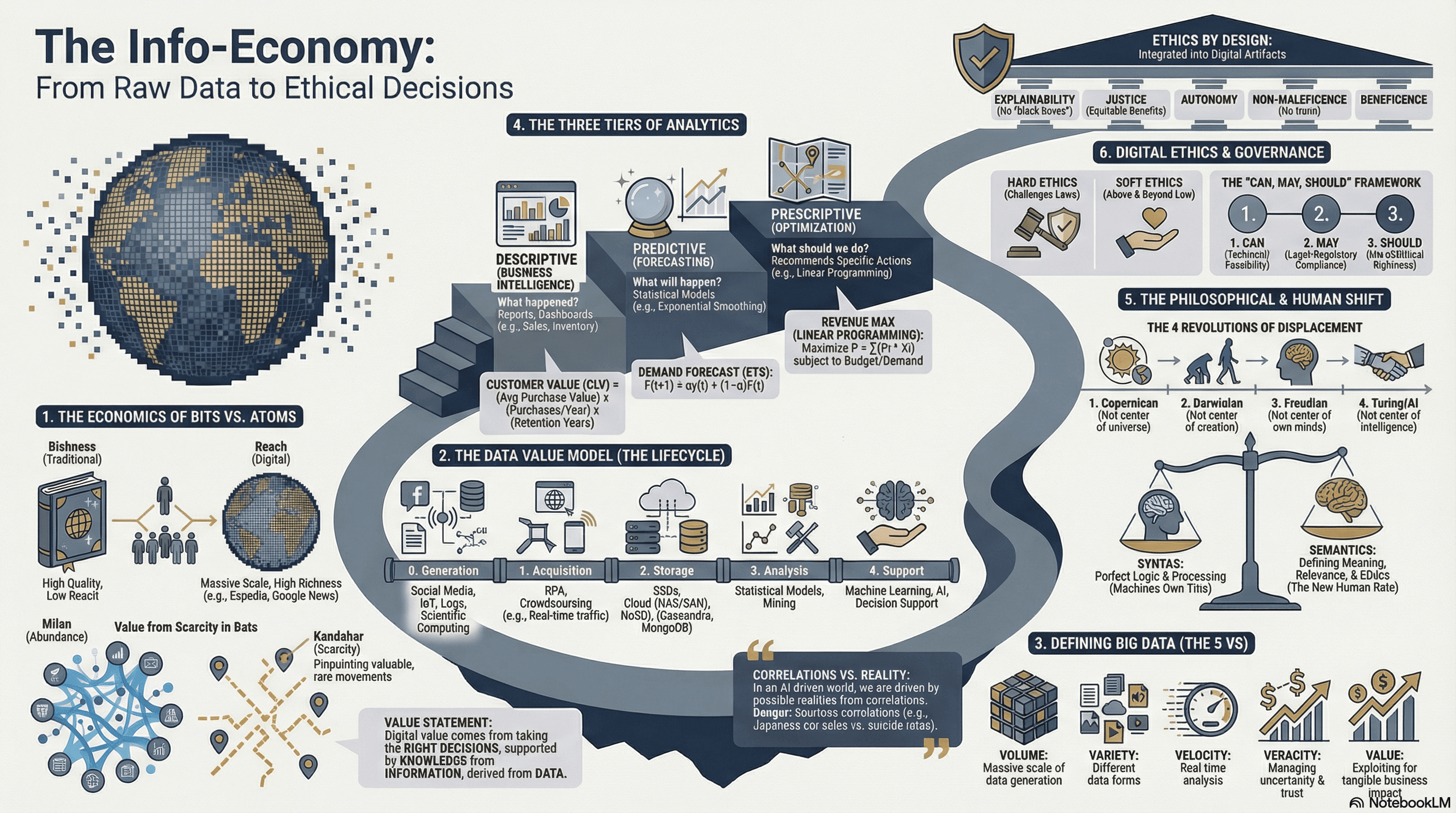
1. Economics of Bits vs. Atoms
The fundamental economic shift of the digital age is the transition from physical (atoms) to information (bits) as the primary source of value creation.
Three Foundational Axioms
-
Bits are cheaper to produce, store, and transmit than atoms
- Marginal cost of digital replication approaches zero
- Physical distribution requires logistics infrastructure
-
Bits scale infinitely; atoms do not
- Digital products serve unlimited users simultaneously
- Physical products face capacity constraints
-
Bits enable personalization at scale; atoms require mass production
- Digital customization is computationally trivial
- Physical customization is economically prohibitive
Strategic Question: Where does your value come from—atoms, bits, or the interface between them?
2. Richness vs. Reach Paradoxes
Traditional economics suggested a trade-off between richness (quality/depth of information) and reach (number of people accessed). Digital economics breaks this constraint.
Paradox 1: Value from Quantity (Expedia vs. Traditional Travel Agents)
Traditional Model: Human travel agents provided rich, personalized service but served limited clients.
Digital Model: Expedia provides comprehensive options to millions simultaneously, creating value through breadth rather than depth.
Lesson: Reach can create its own form of richness through comprehensive optionality and network effects.
Paradox 2: Value from Intermediaries (Google News vs. Newspapers)
Traditional Model: Newspapers created and owned content, capturing full value chain.
Digital Model: Google News creates no content but aggregates and organizes, capturing significant value through intermediation.
Lesson: Curation and discovery can be more valuable than creation in information-abundant environments.
Paradox 3: Value from Scarcity (Strava Heat Maps: Milano vs. Kandahar)
Context: Strava inadvertently revealed military base locations in conflict zones through aggregated running data.
Traditional Economics: Scarcity creates value (rare information is valuable).
Digital Economics: Abundance creates insight (patterns emerge from volume).
Lesson: In the info-economy, ubiquity can be more strategically valuable than scarcity.
3. The Value Hierarchy: From Data to Decisions
The Knowledge Pyramid
The transformation from raw data to strategic action follows a hierarchical progression:
| Level | Description | Transformation |
|---|---|---|
| 4. Decisions | Strategic Action | Knowledge → Action |
| 3. Knowledge | Insights & Patterns | Information → Understanding |
| 2. Information | Structure + Semantics | Data → Context |
| 1. Data | Raw Observations | Capture → Storage |
Key Transformations:
- Data → Information: Adding structure and semantic layers (context, relationships)
- Information → Knowledge: Extracting insights and identifying patterns
- Knowledge → Decisions: Converting understanding into actionable strategies
Real-World Example: Crowdsourced Infrastructure
- Data: GPS coordinates of road surface impacts (acceleration data)
- Information: Tagged pothole locations with severity ratings
- Knowledge: Road degradation patterns and maintenance prediction models
- Decisions: Optimized infrastructure investment and preventive maintenance schedules
4. The Big Data Value Model & Extended Value Chain
The 5 Stages
- Generation: Creating data through sensors, transactions, interactions
- Acquisition: Collecting and ingesting data streams
- Storage: Persisting data in accessible formats
- Analysis: Extracting insights and building models
- Support: Governance, security, quality assurance
The 3+2 Vs of Big Data
Core 3 Vs:
- Volume: Scale of data (Terabytes to Zettabytes)
- Variety: Structured, semi-structured, unstructured formats
- Velocity: Speed of data generation and processing requirements
Extended 2 Vs:
- Veracity: Data quality and trustworthiness
- Value: Economic utility of insights extracted
Critical Insight: Volume, Variety, and Velocity define the technical challenge. Veracity and Value define the business challenge. Most organizations over-invest in the former and under-invest in the latter.
5. Technical Infrastructure of Information
Storage Models
- NAS (Network-Attached Storage): File-level storage for centralized access
- SAN (Storage Area Network): Block-level storage for high performance
- HDFS (Hadoop Distributed File System): Distributed storage for Big Data
- NoSQL Databases: Schema-flexible storage (Cassandra, MongoDB)
Programming Models
- MapReduce: Parallel processing framework for distributed computation
- Stream Processing: Real-time data analysis (Kafka, Flink)
The Semantic Layer
Information exists in three forms:
- Information as the World: Physical reality (temperature, location)
- Information for the World: Instructions and recipes (how-to guides)
- Information about the World: Meta-knowledge (reviews, analytics)
6. The Analytics Spectrum
Descriptive Analytics: "What happened?"
- Purpose: Understanding historical patterns
- Techniques: Aggregation, visualization, reporting
- Business Value: Baseline awareness and performance tracking
- Example: Monthly sales reports, website traffic dashboards
Predictive Analytics: "What will happen?"
- Purpose: Forecasting future outcomes
- Techniques: Regression, classification, time series analysis
- Business Value: Proactive resource allocation and risk management
- Example: Demand forecasting, customer churn prediction
Prescriptive Analytics: "What should we do?"
- Purpose: Recommending optimal actions
- Techniques: Optimization algorithms, decision modeling, reinforcement learning
- Business Value: Automated decision-making and strategy optimization
- Example: Dynamic pricing, supply chain optimization, personalized recommendations
Maturity Progression: Most organizations begin with descriptive analytics, evolve to predictive capabilities, and aspire to prescriptive automation. Each stage requires exponentially greater data quality and analytical sophistication.
7. Machine Learning Bias and Digital Ethics
Sources of ML Bias
- Training Data Bias: Historical data reflects historical discrimination
- Algorithm Bias: Model design choices embed assumptions
- Interaction Bias: Feedback loops reinforce initial biases
- Deployment Bias: Differential impact across demographic groups
Real-World Example: Hiring Algorithms
Amazon's experimental hiring algorithm was discontinued after it demonstrated gender bias, penalizing resumes containing the word "women's" (as in "women's chess club"). The model learned from historical hiring patterns, which skewed male in technical roles.
Lesson: "Objective" algorithms trained on biased data perpetuate discrimination while appearing neutral.
Ethical Frameworks for AI
- Transparency: Can decisions be explained and audited?
- Accountability: Who is responsible for algorithmic outcomes?
- Fairness: Are impacts equitably distributed across groups?
- Privacy: Is personal data collected, used, and stored appropriately?
- Safety: Are risks identified and mitigated?
8. Servitization: From Products to Outcomes
Servitization is the transformation from selling products to selling outcomes, enabled by data connectivity.
Traditional Model: Selling Equipment
- Transaction: One-time sale of machinery
- Revenue: Upfront capital expenditure
- Relationship: Transactional, ends after sale
- Risk: Customer owns performance uncertainty
Servitized Model: Selling Uptime/Outcomes
- Transaction: Subscription or performance-based contract
- Revenue: Recurring, aligned with value delivered
- Relationship: Ongoing partnership with shared incentives
- Risk: Provider owns performance uncertainty (creating alignment)
Example: Rolls-Royce "Power by the Hour"
Rolls-Royce shifted from selling jet engines to selling flight hours. Sensors monitor engine performance continuously, and Rolls-Royce ensures reliability through predictive maintenance. Airlines pay for uptime, not equipment.
Business Model Implications:
- Continuous data streams create visibility
- Predictive analytics enable proactive maintenance
- Recurring revenue stabilizes cash flows
- Customer and vendor incentives align (both benefit from reliability)
Key Takeaways
-
Bits Economics Breaks Traditional Constraints: Zero marginal costs, infinite scalability, and mass personalization redefine competitive dynamics.
-
Richness vs. Reach is Obsolete: Digital platforms can simultaneously achieve depth and breadth, creating new forms of value through aggregation and curation.
-
Data is Not Information: Climbing the knowledge pyramid from raw data to actionable decisions requires deliberate investment in structure, semantics, and analytical capabilities.
-
The 3+2 Vs Reveal the Gap: Technical capabilities (Volume, Variety, Velocity) matter less than business capabilities (Veracity, Value). Quality and utility trump quantity.
-
Analytics Maturity is Sequential: Descriptive → Predictive → Prescriptive represents a capability ladder. Organizations cannot skip rungs.
-
Bias is Baked In: Machine learning reflects the data it learns from. Historical inequities perpetuate unless deliberately countered.
-
Servitization Realigns Incentives: Selling outcomes instead of products creates shared success metrics and transforms customer relationships from transactional to strategic.
Key Questions
-
Analyze the economic transition from "atoms to bits" using the F&B industry as your case study. Explain how this shift challenges traditional business models in food manufacturing, distribution, and retail. Include specific examples of companies successfully navigating this transition.
-
Critically evaluate the "Richness vs Reach" paradox in the context of personalized nutrition platforms. How do digital technologies enable the simultaneous achievement of both high richness (personalized meal plans, nutritional advice) and high reach (millions of users)? What are the remaining constraints?
-
Using the Knowledge Pyramid framework, trace the transformation of raw sensor data from a smart warehouse into strategic inventory management decisions. Identify the value-adding processes at each level (Data → Information → Knowledge → Decisions) and the analytical techniques required.
-
Compare descriptive, predictive, and prescriptive analytics in terms of strategic value and implementation complexity. For an F&B supply chain scenario (e.g., demand forecasting, route optimization), explain which analytics approach would be most appropriate and why, including ROI considerations.
-
Examine the ethical dimensions of algorithmic bias in F&B applications. Provide a concrete example where biased training data could lead to discriminatory outcomes (e.g., credit scoring for suppliers, hiring algorithms, customer segmentation). Propose a governance framework to mitigate these risks, incorporating technical, organizational, and regulatory measures.
Discussion Prompts
-
Evaluate your primary product or service: Is value derived from atoms, bits, or their interface? What would a "bits-first" redesign look like?
-
Identify a business process currently operating at the Descriptive Analytics level. What would be required to elevate it to Predictive or Prescriptive maturity? What barriers exist?
-
Consider a critical decision-making algorithm in your organization (credit approval, hiring, resource allocation). What biases might exist in the training data? How would you audit and mitigate them?
Further Reading
- Floridi, L. (2016). The Fourth Revolution: How the Infosphere Is Reshaping Human Reality. Oxford University Press.
- Mollick, E. (2024). Co-Intelligence: Living and Working with AI. Portfolio.