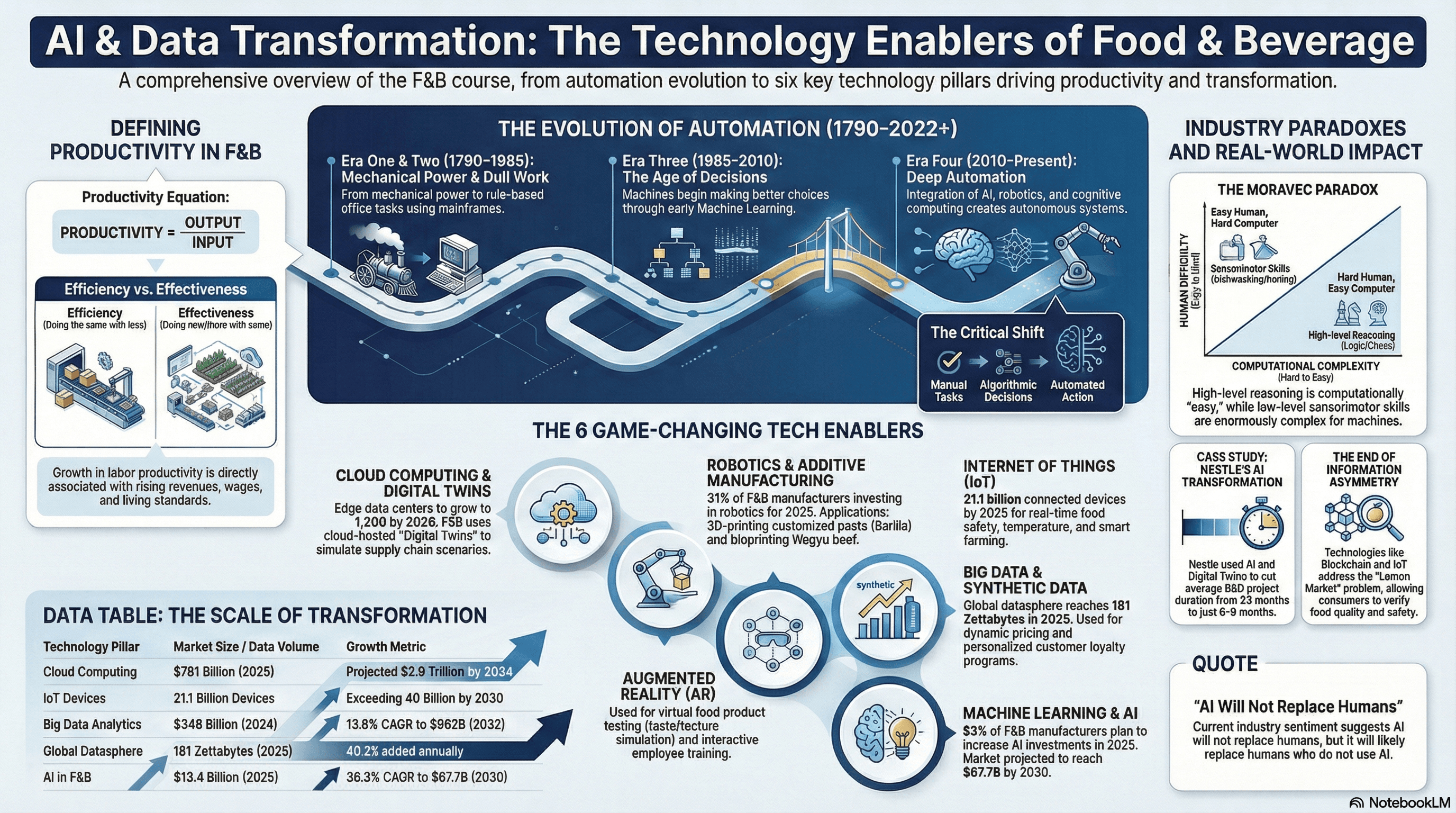
1. The Age of the Exponential: Historical Context of Automation
The contemporary technological landscape is characterized by exponential growth, a phenomenon that has fundamentally altered the competitive dynamics of the Food & Beverage industry. Understanding this trajectory requires historical context.
The Four Eras of Automation (1790-Present)
- First Industrial Revolution (1790-1840): Mechanization through water and steam power
- Second Industrial Revolution (1870-1914): Mass production via electricity and assembly lines
- Third Industrial Revolution (1969-2000s): Digital automation through computing and electronics
- Fourth Industrial Revolution (2010-Present): Cyber-physical systems, AI, and IoT convergence
The Exponential Growth Curve
The distinguishing characteristic of the Fourth Revolution is the exponential acceleration of technological capability. While previous eras saw linear or incremental improvements, modern technologies follow Moore's Law and its derivatives, doubling in capability while halving in cost approximately every 18-24 months.
Critical Insight: Organizations that plan using linear projections in an exponential world will consistently underestimate disruption and overestimate their competitive moat.
2. The Productivity Paradox: Technology vs. Realized Value
Despite unprecedented investment in technology, many F&B organizations struggle to translate digital capabilities into measurable productivity gains. This mirrors the historical "Productivity Paradox" of the early 20th century electrification era.
The Productivity Formula
Productivity = Output (Value Created) / Input (Resources Consumed)
Efficiency vs. Effectiveness
- Efficiency: Doing things right (optimizing existing processes)
- Effectiveness: Doing the right things (reimagining value creation)
The Productivity Paradox emerges when organizations pursue efficiency improvements while neglecting effectiveness transformation. Installing AI tools in legacy workflows is akin to replacing steam engines with electric motors while maintaining 19th-century factory layouts.
The 30-Year Lag Lesson
Historical analysis reveals that productivity gains from electrification materialized only after 30 years, once workflows were fundamentally redesigned. Modern AI adoption faces similar organizational inertia: technology is not the constraint; organizational design is.
3. Infrastructure and Connectivity: Cloud Computing & IoT
Cloud Computing: The Foundation Layer
The cloud computing market represents the foundational infrastructure for digital transformation:
- 2025 Market Size: USD 781 billion
- 2034 Projection: USD 2.9 trillion
- CAGR: 15.7%
F&B Applications:
- Digital Twins for production optimization
- Smart kitchens with real-time recipe adaptation
- Supply chain visibility and predictive maintenance
IoT: The Sensor Network
The Internet of Things creates a pervasive sensing layer, converting physical operations into data streams:
- 2034 Projection: 40.6 billion connected devices
- Market Value: USD 2.72 trillion
- Data Generation: 73 Zettabytes in 2025
Smart Farming Applications:
- Soil moisture and nutrient sensors for precision agriculture
- Livestock monitoring for health and welfare
- Climate-controlled growing environments
- Automated irrigation and feeding systems
4. Physical Innovation: Robotics & Additive Manufacturing
Robotics in F&B
The F&B sector has seen a 21% increase in robot installations in 2024, with 31% of manufacturers planning increased investment. Applications range from packaging automation to quality inspection.
Strategic Imperative: Labor scarcity and consistency requirements are driving rapid adoption, particularly in repetitive or hazardous tasks.
Additive Manufacturing (3D Printing)
Additive manufacturing is transitioning from prototyping to production, enabling:
- Mass Customization: Personalized nutrition and dietary requirements
- Complex Geometries: Designs impossible with traditional methods
- Waste Reduction: Precise material usage
Case Study: Barilla 3D-Printed Pasta Italian pasta manufacturer Barilla has developed 3D-printed pasta designs with complex geometries that optimize sauce retention and cooking properties. This represents a shift from industrial standardization to artisanal-scale personalization.
Case Study: Osaka University Bioprinted Wagyu Researchers successfully bioprinted Wagyu beef, replicating the marbling patterns that define this premium product. While currently experimental, this technology trajectory suggests potential disruption of traditional livestock agriculture.
Case Study: DayTwo Personalized Nutrition DayTwo uses microbiome analysis and machine learning to provide personalized dietary recommendations, demonstrating how data-driven precision can replace one-size-fits-all nutritional guidance.
5. Enhanced Perception: Augmented Reality (AR)
Augmented Reality overlays digital information onto physical environments, creating enhanced decision-making contexts.
Four F&B Applications
- Worker Training: Interactive, step-by-step assembly or maintenance instructions
- Quality Control: Real-time defect detection with visual overlays
- Equipment Maintenance: Remote expert assistance and diagnostic visualization
- Consumer Experience: Interactive packaging and product information
Data Context: IoT sensors generate 73 Zettabytes of data in 2025, much of which becomes actionable only when visualized contextually through AR interfaces.
6. The Intelligence Layer: Big Data, Synthetic Data, AI/ML
Market Dynamics
- Analytics Market: USD 962 billion by 2032
- F&B AI Market: USD 67.7 billion by 2030 (CAGR 38.3%)
- Implementation Gap: 97.4% of companies invest in AI, but only 40% use it effectively
The Implementation Gap
This disparity reveals a critical insight: technology acquisition is not synonymous with capability development. Effective AI deployment requires:
- Data infrastructure and governance
- Analytical talent and organizational literacy
- Process redesign and change management
- Ethical frameworks and regulatory compliance
Synthetic Data: Augmenting Reality
As data becomes the raw material of intelligence, synthetic data generation emerges as a strategic capability. Machine learning models can create realistic but artificial datasets for training purposes, overcoming:
- Privacy Constraints: Generating customer behavior data without exposing individuals
- Rare Event Scenarios: Creating edge cases for testing (product recalls, contamination events)
- Data Scarcity: Augmenting limited real-world observations
7. Navigating the Human-AI Paradox
The Polanyi Paradox
"We know more than we can tell" - Michael Polanyi
Human expertise often operates at a tacit level. An experienced quality inspector can detect subtle defects but may struggle to articulate the exact criteria. This creates challenges for codifying expertise into algorithms.
Implication: AI excels at explicit, rule-based tasks but struggles with tacit knowledge. Hybrid human-AI systems that leverage complementary strengths will outperform pure automation.
The Moravec Paradox
"It is comparatively easy to make computers exhibit adult-level performance on intelligence tests or playing checkers, and difficult or impossible to give them the skills of a one-year-old when it comes to perception and mobility." - Hans Moravec
Implication: High-level reasoning (strategy, optimization) is computationally simpler than sensorimotor skills (dexterity, navigation). Automation will continue to replace cognitive work before fully replacing physical tasks.
Human-Only Skills (For Now)
| Capability | Why AI Struggles | Strategic Value |
|---|---|---|
| Empathy & Emotional Intelligence | Lacks lived experience and emotional grounding | Customer relationships, team leadership |
| Creative Synthesis | Pattern recognition, not novel conceptual leaps | Innovation, brand differentiation |
| Contextual Judgment | Brittle to edge cases and novel situations | Crisis management, strategic pivots |
| Ethical Reasoning | No moral agency or value system | Stakeholder trust, regulatory navigation |
Key Takeaways
-
Exponential Thinking is Essential: Linear planning strategies fail in exponential technology environments. Organizations must develop scenario-based planning that accounts for rapid capability shifts.
-
The Productivity Paradox is Organizational, Not Technological: Technology alone does not create value; redesigned workflows and business models do. Efficiency without effectiveness is futile.
-
Cloud and IoT Create the Foundation: These infrastructure technologies enable all other innovations. Without robust data generation and processing capabilities, advanced AI remains hypothetical.
-
Physical and Digital Converge: Robotics, 3D printing, and AR represent the fusion of cyber and physical systems. The F&B industry's inherent physicality makes this convergence strategically critical.
-
The Implementation Gap is the Real Challenge: 97.4% investment but only 40% effective deployment reveals that organizational capability, not technology access, is the binding constraint.
-
Human-AI Complementarity, Not Replacement: The paradoxes of Polanyi and Moravec demonstrate that human and machine capabilities are asymmetric. Optimal systems leverage both.
Key Questions
-
Explain the Productivity Paradox observed during the electrification era (1890-1920) and its modern parallels in AI adoption. What organizational factors prevented immediate productivity gains, and how do these lessons apply to contemporary F&B digital transformation strategies?
-
Compare and contrast the four enabling technology layers (Cloud, IoT, Robotics, AR) in terms of their strategic impact on F&B value chains. Provide specific examples of how each layer addresses different competitive challenges in the industry.
-
Analyze the relationship between Big Data and Synthetic Data in the context of training machine learning models. What are the advantages and limitations of each approach, and in which F&B scenarios would synthetic data be strategically preferable?
-
Using the Polanyi Paradox and Moravec Paradox as frameworks, identify which F&B tasks are most susceptible to automation and which remain resistant. Justify your classification with specific examples from manufacturing, supply chain, or customer service contexts.
-
Evaluate the statement: "3D printing and mass customization represent a strategic opportunity rather than an operational efficiency gain for F&B companies." Support your argument with economic analysis (unit economics, market segmentation) and technical feasibility considerations (materials, speed, regulatory constraints).
Discussion Prompts
-
Identify three processes in your organization where efficiency improvements (doing things right) are occurring without effectiveness evaluation (doing the right things). What would a fundamental redesign look like?
-
For a physical product you're familiar with, sketch a 3D printing or personalization strategy. What would be the value proposition? What technical and economic barriers exist?
-
Consider the Moravec Paradox in your context: Which cognitive tasks could be automated today? Which sensorimotor tasks remain exclusively human? What does this suggest about workforce evolution?
Further Reading
- Floridi, L. (2016). The Fourth Revolution: How the Infosphere Is Reshaping Human Reality. Oxford University Press.
- Mollick, E. (2024). Co-Intelligence: Living and Working with AI. Portfolio.